About Us
Buying Stations
Fisherman Bio's
Processing
Q & A
Information & News


Copyright©2012 Oregon Seafoods
Smoke House
Cold Smoke
When filling our smokehouse, we slice loins into smaller chunks and fill the racks. The racks are placed horizontally onto a cart, commonly called a smokehouse truck. The truck gets wheeled into the smoker and alder chips are burned in a separate smoke generating unit. The smoke is sucked into and circulated around the meat for several hours penetrating the meat giving it a nice smoky flavor. The racks are then unloaded and the meat is portioned out to the correct weight and hand filled into the pouches to be sealed and cooked.
Hot Smoke
Again, the loins are cut into smaller chunks and loaded onto the racks to go into the smoker. While the temperature rises, smoke is pushed into the smokehouse from the smoke generator. The fish is smoked (cooked) for a couple of hours and comes out ready to eat. There are markets that take the fresh smoked product and sell it right away. The rest of the fish will get vacuumed packed and frozen right away down to at least zero degrees. That will hold the smoked fish in perfect condition.
       
Hot Smoked Albacore
in vacuum packed bags
       
Hot Smoked Albacore
in vacuum packed bags
Fresh & Frozen Loins
Loins
During the normal processing of fish, loins are produced. At the cannery/pouch facility most of those loins are sliced to go into cans or pouches. We do have some customers that have a market for loins.  Chefs at restaurants, for instance, prefer whole loins. We process our fish at ice cold temperatures and then vacuum pack them to keep them fresh. They can be frozen or picked up fresh. Home canners prefer loins as they can cut the loins to their desired lengths.
       
       
Cans
There are several different small can sizes. We process the two most popular sizes: 6oz and 7 1/2 oz. The 6oz can (307x111) is about 1 5/8” tall and the 7 1/2oz can (307x200.25) is about 2” tall. The lid can be a standard end requiring a can opener or the lid can be an EZO end commonly referred to a pop top lid.

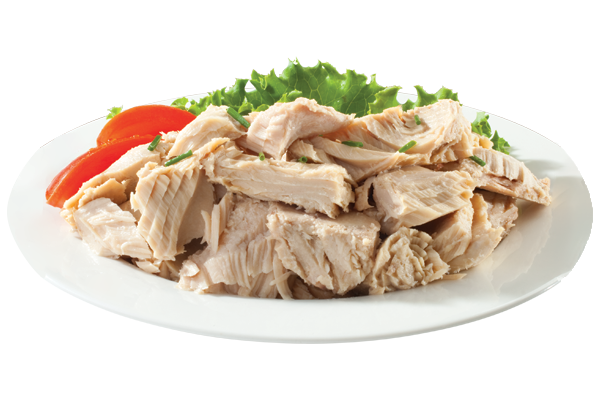
There are options on how the cans get packed. The most common is a commercial pack. The meat is portioned out and pushed down into a can. When the can is opened, the meat appears to be one chunk (looking like the shape of a hockey puck). It can be dumped into a bowl and broken up to be prepared to use in whatever fashion. The gourmet pack involves slicing the loin at the desired length so it can be placed into the can on its side ‘end grain up’. The gourmet pack focuses on presentation for those customers who care about what their fish looks like when they open the can.
 
There are a variety of flavor options. If you have a certain recipe that you would like us to pack, we would have to get a process letter to cover it and file it with the USDA. That can take up to 4 or 5 weeks to complete depending on the time of year.

For a complete list of everything we produce now, go to:
  
       
Pouches
Retail
Food Service
Food Service
Food service pouches are larger, ranging in net weight from 1lb to 4lbs. At Oregon Seafoods we regularly produce 2lb and a 4lb pouches. The 2lb pouch measures 8”wide x 10”long and the 4lb pouch measures 10”wide x 14”long. The multilayered pouches are made similarly to the pouches noted on the retail page: polypropilene lining, nylon barrier then aluminum foil. They are one inch thick and chefs have found they are convenient for use in the kitchen.

We do not produce albacore tuna in a food service sized can. We have the equipment needed to do so but feel that the pouch is so far superior in quality and taste, that there is no advantage to using a can - only liabilities. For example, the 4lb can has approximately a 4 hour cook time and the tuna inside continues to cook after it is removed from the cooker for several more hours. The cook time on a pouch is 73 minutes and when the cook cycle is complete, we flood the cooker with cold water to stop the cooking process. The product quality difference is huge. Chefs prefer the 1” think pouch for its ease of use as opposed to the big chunk of meat that comes out of a can. Because the pouches lay flat, more of the tuna is laying in its natural juices keeping it moist and flavorful. There are also safety considerations and disposal issues when dealing with the large cans. After using the pouch, you’ll quickly agree that it’s a better product and more convenient to use.
       
       
Retail
Retail size pouches generally range from 3oz to 8oz. The size of the pouch can be as skinny as 5” and as wide as 7”. The pouch can be as short as 5” and as long as 9”. We process pouches that are pre-printed as well as plain silver or gold pouches that have an adhesive label applied after processing. Retort pouches are usually made up of four layers. The first layer or food contact side is Polypropylene and does not contain any BPA. The next layer is aluminum which seals out air and protects the food followed by nylon which adds strength and puncture resistance. The top, final layer is polyester which allows the pouch to be printed on.
       
       
Co-Pack
Oregon Seafoods packs for various customers in cans and pouches. We receive fish at our Coos Bay facility and process and package per our customers’ specifications. For packaging options click on the cans, pouches, or loins tabs. Please call the plant to discuss volumes and pricing information. We also supply no-label cans so customers can purchase our tuna ready to go and wrap on their own custom label.  For more information on the following companies or products, click on their respective link.
 LOGO      
Company A
 LOGO    
Company B
Species
Albacore
       
Thunnus alalunga is the tuna fish known to us as albacore or long fin. It is quite often marketed as white meat tuna. Albacore tuna is a highly migratory tuna found in several oceans around the world but most predominately in the Pacific. They mature relatively early, at approximately 6 years and have a moderate lifespan of 10 to 12 years.

Albacore are generally considered inherently resilient to fishing pressure because they:
 ■ Have a high rate of intrinsic increase
 ■ Mature at an early age
 ■ Produce many eggs, about 2.6 million per spawning
 ■ Are not long-lived
 ■ Have a broad distributional range
 ■ Do not exhibit any characteristics that increase the ease or population consequences of capture

As a highly migratory species, albacore are targeted by a number of different fishing fleets from several nations. However, information from all fisheries catching albacore tuna is available and helps to overcome this potential problem.

Trolling for albacore consists of towing artificial lures with barbless hooks, ‘trolls’, behind a fishing vessel at a speed of about 6 knots. If fisher sees or feels a tuna on a line they pull it in. Trolling brings fish to the surface and helps to locate schools of albacore. The vessel stops near the school, and fishers keep the school close by throwing small amounts of live fish chum, often anchovy.

In pole-and-line fishing, individual fishers use a stout pole, formerly constructed of bamboo and now made of fiberglass or a high-technology composite, with a short line that has a single barbless hook with either an artificial lure or live bait.
Fishers may use one or both of these methods together for harvesting. Both are notably ‘clean’ fishing methods that catch one fish at a time. The absence of nets in both methods ensures the fishery is ‘dolphin free’.
       
oregonalbacore.org
   
Crab
       
Cancer Magister also known as Metacarcinus magister is plentiful and is managed for sustainability off the Oregon Coast by ODFW.

Harvest Method: Dungeness crab are caught in circular steel traps commonly called 'pots'. Weighing anywhere from 60 to 125 lbs and measuring 36” to 48” in diameter, each pot has a length of line and a buoy attached to mark its position for retrieval. The pots are baited with squid or razor clams to attract the bottom-dwelling crabs, and set on the ocean floor following the contour of the adjacent coastline. They are allowed to 'soak' for a one to four-day period, depending on the fishing conditions, weather and time of year. The average boat fishes 300-500 pots in depths of 5-100 fathoms (30 to 600 feet) of water. After being brought to the surface by a hydraulic power-block, the crabs are sorted and kept alive on-board the vessel in circulated seawater until they are delivered to shore-side processing plants.

Only mature male crabs measuring 6 ¼” across the shell are harvested. Juvenile males and all females are returned to the sea to insure healthy stocks for future harvests.

Seasons: The ocean crab season along the Oregon coast begins on December 1 and continues through August 14. The peak harvest occurs during the first eight weeks of the season with up to 75% of the annual production landed during this period. Effort traditionally decreases in the spring as fishermen gear up for other coastal fisheries, but fresh crab continues to be available throughout the summer months thanks to a small number of boats that fish right up to the closure in August.
       
oregondungeness.org
   
Salmon
       
Chinook salmon often referred to as King salmon is a wild species that is caught with hook and line off our Oregon Coast. We do process other wild caught salmon species sourced from Alaska; those include Sockeye Salmon often referred as red salmon and Coho Salmon often referred to as Silver Salmon.

       
oregonsalmon.org
   
Contact Us
723 South 2nd Street
Coos Bay, Oregon 97420

Sales@oregonseafoods.com
Mike@oregonseafoods.com
James@oregonseafoods.com
Plant Main Number
541.266.TUNA (8862)
Facility
Fillet Room
       
YouTube Link Here
The fillet room has eight new modern work stations giving filleters plenty of room to hand fillet and prepare the fish for packaging. The room is temperature controlled keeping the fish meat cold throughout the process. Fish are brought into the room at minus temperatures and put into insulated tanks filled with water to slowly thaw overnight. Ice forms around the fish as it thaws slowly bringing the internal temperature up to 31 degrees. Fish are carefully handled one at a time as the fillets are removed and readied for the slicer. Filleting the fish at these ice cold temperatures insures a high quality, flavorful product.


Canning Line
       
YouTube Link Here
The can line uses a canco 06 seamer to lid the cans. The line is set up to run 40 to 50 cans a minute depending on the can pack (see co-pack under processing). The cans are de- palletized and inspected in the can loft before running down the can track to the patch table. Up to six people can be filling and weighing cans before they are placed on the conveyer to go to the seamer. After the lid is put on, the cans are washed in an automatic can washer and transferred to a mag belt where the date is ink jetted on the bottom for future identification. The cans are then loaded into a cart with a busse system and head for the cooker.
Pouch Machine
       
YouTube Link Here
There are two Toyo Jidoki pouch machines: a TVP E-3 and a TVP E-5 made in Japan. They pick up a pouch, open it up, present it to the operator for hand fill, put the pouch into a vacuum chamber, pull most of the residual air out to the package, then seal it tight. The average speed of the E-3 in our hand fill operation is about 14 pouches a minute. The speed of the E-5 is about 5 pouches a minute as we are hand filling 4lbs of meat.
Smoker
       
YouTube Link Here
We smoke everything in a Koch smoker using real smoke to add a mild smoky flavor to our fish. The smoked fish products that end up in our grocery and sport pouches are  cold smoked then put into the pouch to be cooked once which gives it a nice flavor without drying the meat out. We also produce hot smoked products that can be sold fresh or vacuumed packed and sold frozen. 
Management
Mike Babcock
       
Mike is a visionary with ability to put all the pieces together to take an idea and build a business where nothing had existed previously.  With a couple of successful startups in the wood products industry, Mike left what he knew best to start down a new path in food.  “Quality food is going to become increasingly more important and we are interested in positioning Oregon Seafoods as a company people can trust and rely on to help meet their nutritional needs.”


James Elstad
       
James has been part of the company from day one initially helping his friend Mike install equipment and getting the facility to where it is today. A student studying business, James will be taking on more leadership roles in the company as time goes on. Currently, he handles most special projects and is involved in marketing.
Brandy Rohde
       
Brandy comes to Oregon Seafoods with 20 years of experience in the canning industry. Her knowledge of fish processing, food processing, and HACCP guidelines, along with her food safety attitude, made her the obvious choice to manage the day to day operations of the plant. Brandy also coordinates the warehouse and shipping.
Mike Johnson
       
Mike J was brought on board during the summer of 2012 to help manage the fillet room and movement of fish. His several years of experience working at a cannery in a similar role, along with his whatever it takes attitude, makes him the perfect candidate to fill the role.
Mission Statement
The mission of Oregon Seafoods is to partner with our employees and local fishermen to provide high quality, healthy, nutritious, natural fish products at a reasonable price for our customers orchestrating our combined efforts to foster and develop economic opportunities for community sustainability.
History
Sea Fare Pacific was started in early 2011 by Mike Babcock, a native Oregonian and founder of Oregon Seafoods, LLC. Mike was driven by his passion to provide customers with a high quality, naturally nutritious product from wild caught albacore tuna.

It was after spending time with fishermen looking for better marketing opportunities that Mike, an avid sports fisherman himself, conceived the idea of producing a high-end, once-cooked albacore tuna product. Mike was very familiar with the unmatched taste of home canned albacore tuna, since his friends and family often canned their own. Knowing that there is no comparison between home-canned tuna and twice-cooked products often found on grocery shelves, Mike realized that if he could retain the tuna’s natural flavor and health benefits by recreating the home canning process of albacore tuna on a larger scale, it would benefit the consumer as well as the fishermen.

Fully committed in his new endeavor to support certified sustainable Northwest Fishing families, Mike then met with experienced and respected albacore fishing veterans who urged him to use an earth-friendly, BPA-free pouch for his tuna instead of a can.  Supported by testing done at the Oregon State University Seafood Research Laboratory in Astoria, Oregon, Mike decided that putting the tuna in pouches was a better alternative to the can.

Starting a business from scratch is nothing new to Mike as he has a long track record of developing new ventures from the ground up. His previous major start up with no prior experience was in wood products industry in 1993 with Northwest Fir Products. This evolved into a partnership and expanded into the successful Goshen Forest Products which Mike was a part of for 18 years then sold before starting Oregon Seafoods.

As result of growing up on a farm in Brownsville, Oregon, Mike has had an interest in the food industry from an early age. Mike’s Oregon Seafoods business emerged almost by accident after becoming a partner in a retail fish market in Coos Bay, Oregon. Looking for ways to help the market succeed, Mike decided that a processing facility could help the business.  Now after investing a million dollars of his own money in this seafood plant in Coos Bay, Mike has dedicated all of his efforts to the growth and success of Sea Fare Pacific.


     Oregon Seafoods LLC, Coos Bay, Oregon  
OSU Seafood Research Lab 
OSU Food Innovation Center
SeaFarePacific.com

After conducting much research into processing albacore tuna in a pouch, Mike purchased two Toyo Jidoki pouch machines for Oregon Seafoods’ facility in Coos Bay, Oregon. Mike worked with the OSU Seafood Research Lab to develop recipes and Seafood Processors Association to develop appropriate cook times for pouched albacore tuna. As a result four flavors of albacore tuna, salt free, sea salt, jalapeno and smoked, were introduced packaged in 6oz. pouches free of preservatives or fillers.

The services of the Food Innovation Center in Portland, Oregon were enlisted, conducting an extensive consumer sensory test which included a food group participation study. The result was invaluable feedback on the new recipes and packaging allowing Oregon Seafoods to confidently move forward in producing the Sea Fare Pacific menu. The dedication and commitment by all valued participants resulted in the creation of these superior pacific albacore tuna products that make up Sea Fare Pacific’s line.

Word is spreading quickly that Sea Fare Pacific’s fresh, albacore tuna in a pouch offer superior quality on every level. Mike anticipates the far reaching impact that Sea Fare Pacific is going to have for fishermen and fishing communities as the company continues to grow.

Mike declares it just doesn’t make sense to send our premium pacific caught fish to another country for processing like some tuna companies do when we need jobs to support families here in the US. Oregon Seafoods is in the process of putting together a team of people that will help in launching this brand and ultimately ensuring its success from the guy in the fillet room to the person delivering the finished package. Mike’s hope is that the growth of this business will result in the feeding of many families and the employment of many American workers.

Information & News
Never Tasted Fish Like This Before - Oregon State University Article
Some folks from Oregon State University came out to see what’s going on here in Coos Bay with Sea Fare Pacific’s pouches.
Read what they had to say...
Q & A
What is the difference with your ‘Once Cooked Process’?
Most commercial tuna has been cooked twice to make processing easier, which unfortunately depletes much of the fish’s natural, nutritional value.  Our Albacore Tuna is prepared by hand at ice-cold temperatures before being cooked just once in the pouch, preserving a home-canned fresh taste and 6 times more of the tuna’s Omega3.  So when you open a pouch you will simply find wholesome Albacore delight.
Why the Pouch rather than a Can?
Canned tuna has been popular for more than a century—sometimes canned in mom’s kitchen, but more often purchased at the grocery store.  As popular as this container has been, we have come to realize it is taxing on resources and energy when producing.  In response, Sea Fare Pacific has chosen to package wild caught Albacore in a pouch—preserving mom’s home-canned taste with a more environmentally-friendly container.

We are often asked a couple of questions about the pouch which you may share:  1) What about the concerns with food cooked in plastic?, and 2) can the pouch be recycled?  Just like the can, the pouch is primarily a metal-based container with Aluminum foil at the center of its four layers.  Many Aluminum containers and then lined with BPA, however this is not the case with the Sea Fare Pacific pouch.

The answer to the second question is actually “no,” the pouch cannot be recycled.  But even without the ability to recycle the pouch there is a significantly smaller environmental footprint incurred by the pouch.  Cans require much more raw material, transportation, and storage that making the pouch the more environmentally friendly choice.
Do you source your fish from sustainable resources?
Absolutely! We only process species that are found to be sustainable in their respective fisheries.  Every species we process is on the Seafood Watch  ’green’ list – click the link to see the current pocket guide.
Monterey Bay Aquarium Seafood Watch Guide
Why is sustainability important to your company?
We are interested in protecting the environment for our children, grandchildren, and future generations.  It is important to recognize we are all a part of something bigger than ourselves, and along with that comes responsibility.  At Oregon Seafoods we take pride in the work that we do, as well as the industries and communities we serve.  We feel that in order to preserve our environment and its natural resources we must make a consolidated effort to strive for sustainability by educating ourselves, and leading by example.  We carry this same attitude with decisions made at the plant, which is another reason we pursued and promote pouches over the can.
       
Fisherman's Bio's
Tyler Long
       
YouTube Link Here
Owner of the F/V Harvester, Tyler is part of a rare new breed of fisherman that is willing to work insuring success for his boat and crew.  For his size of boat Tyler consistently is at the top of his class for fish landed.  Not only does he catch fish well, he knows how to take care of them.  The quality of his product for an ice boat is second to none.  The fish are well cared for providing Oregon Seafoods with gourmet quality fish.
Steve Mintz
       
YouTube Link Here
A dedicated fisherman working on his boat F/V DJ for three years in dry dock to get it where it is today.  Steve is a hard working fisherman who provides high quality ice fish and likes our vision of providing high quality albacore tuna to the American market.
Buying Stations
Port Orford
       
       
Port Orford is located about 70 miles north of the California and Oregon Border. The facilities are different from most as the dock (jetty protected) is right in the ocean. There is no bar to cross and there are not the traditional docks to tie up to.  Boats usually get hauled out of the water with their large 25,000 pound capacity boat hoist. For fish selling and buying, there is a smaller fish hoist (provided by the port) available to unload your boat with a limited area to tie up. Ice is available at the port.
Charleston
       
       
Being only 15 minutes from our processing facility in Coos Bay, this is our preferred place to unload and is available by appointment 24/7. We have installed a brand new hydraulic crane located at the ice dock (which is East of the main moorage area just off the main channel). The bright red hoist sits on the Southwest corner of that dock and there is space to tie up a couple of boats. There is ice available from the Port of Charleston at the same dock. Call for the availability of frozen Anchovies.
Winchester Bay
       
      
There is a fish hoist owned and maintained by the Port of Umpqua located inside and near the commercial boat basin and is available on a first come basis. There is no ice in port. There is a live bait seller with limited supply.
Florence
       
       
The Port of Siuslaw maintains a hoist right at the end of Main Street in Old Town. There is a nice dock facility with ample room and plenty of food options just steps away. There is an ice house under construction on the same dock.
Newport
       
    
There is a long public dock with several hoists located right off Bay Blvd at the port offices. The hoists are available on a first come basis and are charged based on boat tie up time. Newport is the largest port with all services available. No live bait.
Welcome to Oregon Seafoods, a custom processing and packaging facility located in Coos Bay, Oregon.
Home of SeaFarePacific.com 
We handle only sustainable wild caught fish and shellfish.
To purchase products we produce, please visit


History
Management
Facility
Contact Us
 
Species
Co-Pack
Pouches
Cans
Fresh &
Frozen Loins
Smoke
House